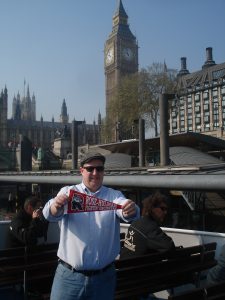
 TERRENCE CASEY is Professor of Political Science at the Rose-Hulman Institute of Technology in Terre Haute, Indiana, USA. From 2018-22 he held the Alfred R. Schmidt Endowed Chair for Excellence in Teaching, and also received the Board of Trustees Outstanding Scholar award in 2012. Casey earned his Ph.D. from George Washington University in 2000, and his dissertation received the Samuel H. Beer Prize for the Best Dissertation on British Politics by the British Politics Group of the American Political Science Association. He later took up the roles of Executive Director (2005-14) and President (2018-20) of the British Politics Group and continues to serve on their elected Executive Committee. He is a Senior Fellow at the Centre for British Politics at the University of Hull, where he delivered their 2019 Annual Norton Lecture entitled, “How the 1970s Shaped Margaret Thatcher – and Our Politics Today,” a lecture based on the research for this book. He is also a Fellow of the Royal Society of Arts.
Casey has published widely on British politics and political economy. His most recent book is Forging the Iron Lady: Margaret Thatcher, the 197os, and the Origins of Neoliberalism (Routledge, 2024). His previous books include The Social Context of Economic Change in Britain (Manchester University Press, 2002), The Blair Legacy, ed. (Palgrave Macmillan, 2009), and The Legacy of the Crash: How the Financial Crisis Changed America and Britain, ed. (Palgrave Macmillan 2011). He has authored numerous peer reviewed journal articles, including “How Macroprudential Regulation Can Save Neoliberalism,” British Journal of Politics and International Relations, 17: 2, May 2015, which elicited a response article (Andrew Baker and Wesley Widmaier, “Macroprudential Ideas and Contested Social Purpose: A Response to Terrence Casey,” BJPIR, 17:2, May 2015.)