Previous works from Terrence Casey
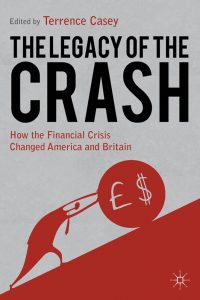
The Legacy of the Crash: How the Financial Crisis Changed America and Britain, Palgrave Macmillan, 2011.
September 2008 saw the most spectacular financial crash since the Great Depression. The crisis prompted record-breaking financial bail-outs in America and Britain. The legacy is record government debt, low growth and a new era of austerity. A stellar cast of contributors, including Tim Bale, Wyn Grant and Graham Wilson provide a sophisticated account of how the administrations are faring. They explore the impact of the crisis and assess how political leaders in both countries have responded, while also looking at the challenges of governing in a new .age of austerity’.
Reviews:
‘The Legacy of the Crash provides timely and expert analysis of the differing political responses in Britain and the United States to the financial crash of 2008. Essential reading for anyone seeking to understand the nature of the crisis and its consequences, which are still unfolding.’ – Andrew Gamble, Professor and Head of Department of Politics, University of Cambridge, UK
‘Just how did we get into the mess of the 2008 financial crisis? And what will be the fallout? These are questions to which every politician and policy maker is keen to know the answer. Where better to look than in the two heartlands of the neoliberal economics Britain and the United States at whose door many lay the blame? Terrence Casey and his colleagues set about this vital task, providing an important and insightful comparative analysis of exactly how the politics and economics of the two countries have so far weathered the financial storm.’ – John Curtice, Professor of Politics, University of Strathclyde, UK
‘A wonderfully enterprising volume. Casey’s collection does superbly what political science should continually do, but hardly ever does: confront urgent contemporary issues in a scholarly and systematic way. This is not the last word on the financial crash, obviously, but it one of the most outstanding to date.’ – Michael Moran, University of Manchester Business School, UK.
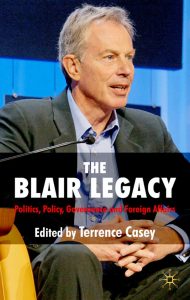
The Blair Legacy: Politics, Policy, Governance, and Foreign Affairs, Palgrave Macmillan, 2009.
Tony Blair was one of the few British premiers to dominate his era. Yet what is his lasting importance? The Blair Legacy offers a comprehensive examination of the long-term impact of Tony Blair’s three Labour governments. Bringing together the foremost scholars from both sides of the Atlantic, this volume explores how New Labour changed the terms of the political debate, established and ideological stamp, reformed public services, revised economic management, transformed governing institutions, and repositioned Britain in the wider world.
Reviews:
‘This is an admirable short-term description and evaluation of the politics, foreign and domestic policies, institutional impact, and general consequences of the Blair governments comprehensive in scope, encyclopaedic in knowledge, careful in judgment, and remarkably integrated and readable.’ – Donley T. Studlar, Eberly Family Distinguished Professor of Political Science, West Virginia University, USA
The Social Context of Economic Change: Between Policy and Performance, Manchester University Press, 2002.
This important book examines a period of dramatic economic change in Britain during the Thatcher era. The Conservatives’ free market policies generally improved the performance of the economy in Britain, but some parts of the country still did poorly (for example northern England). Casey argues that this was as a result of variations in social contexts – a combination of institutions, interests and economic culture. Southern England, possessing a more individualistic culture and higher levels of entrepreneurialism, has a ‘market responsive’ social context that can prosper under free market policies. Social context is thus a crucial intervening variable between the policies selected by decision-makers and the performance of economies, the key for enhancing prosperity is the proper match between economic policies and the context in which they are implemented.
The social context of economic change in Britain provides an original theoretical framework linking economic growth and civil society and offers a unique insight into the Thatcher era. This book will be of interest to students of British politics and comparative political economy, public policy and political history.
Reviews:
“This is a useful book which is empirically rich…As a study in political economy, its consideration of the regional and social dimension in economic development is a welcome one.” –Nicola McEwen, University of Edinburgh.